
Intelligent TSL: The Voicebot as support for handling claims and shipment statuses
Intelligent TSL: The Voicebot as support for handling claims and shipment statuses
The Transport, Shipping, and Logistics (TSL) industry operates on razor-thin time margins, where every second of delay generates costs and the lack of reliable information builds frustration for the end customer. In 2026, the standard is becoming the Intelligent TSL ecosystem, in which artificial intelligence does not replace humans but becomes their most effective support. A key element of this ecosystem is the Voicebot—an advanced inbound tool that takes over the burden of handling claims processes and real-time shipment status monitoring.
In brief: Key takeaways from the article
- In the TSL industry, the Voicebot acts as an intelligent filter that handles 100% of inbound traffic, eliminating the phenomenon of “abandoned calls.”
- Shipment status automation takes place without employee involvement, thanks to the bot’s direct access to TMS and WMS databases.
- Claims processes gain precision through standardized voice interviews and automatic case number assignment in the CRM system.
- Intelligent Inbound enables contact personalization through phone number recognition (Caller ID) and assignment to specific orders in the database.
- The security and resilience of systems based on EasyCall solutions ensure service continuity even during extreme parcel volume peaks.
The new role of inbound communication in modern forwarding
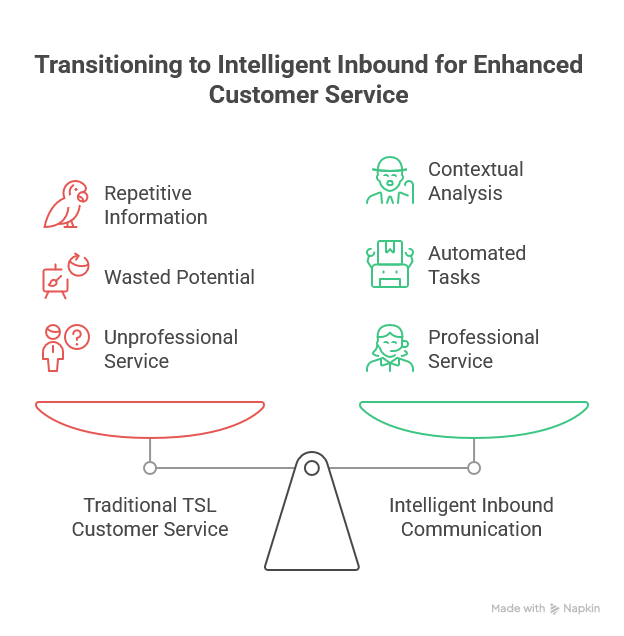
In the traditional TSL customer service model, customer service office (BOK) employees spend most of the day repeating the same information: “the parcel is on the way,” “the courier will arrive in an hour,” “please provide the waybill number.” This wastes the potential of qualified freight forwarders. Deploying an AI voicebot allows these tasks to be shifted into the automated domain. When properly implemented, this type of technology in logistics can automatically handle up to 80% of inquiries.
Intelligent Inbound means that the system not only answers the phone but also analyzes the inquiry’s context. If a customer calls from a number assigned to an active order, the bot can greet them by name and immediately move to the substance of the issue. Such a customer communication strategy makes the service process appear professional and modern, which is critical in competing for both business and individual customers.
Shipment statuses: 24/7 monitoring without staff involvement
The greatest burden on TSL helplines comes from status inquiries. By using a voicebot, a logistics company can offer customers full visibility into the journey of their goods without the need to wait for a consultant connection.
Thanks to integration with tracking systems, the bot verifies the shipment’s location in a fraction of a second and informs the caller about:
- the current stage (sorting facility, handed over to courier, delivery notice),
- the estimated time of delivery (ETA),
- courier details or pickup point information.
The EasyCall system can accurately recognize dictated waybill numbers, which is routine for a virtual consultant but tedious and error-prone for a BOK employee. After the call, the system can automatically send a confirmation or tracking link via SMS, closing the information loop.
Claims: From chaos to structured cases
Claims handling is a high-risk process. Errors at this stage translate directly into financial losses and customer churn. The Voicebot supports the claims department by acting as a precise interviewer.
Instead of a chaotic conversation with a consultant, the bot guides the customer through a standardized process:
- Damage identification: The bot asks about the type of issue (missing parcel, damaged packaging, incomplete contents).
- Data collection: It retrieves the order number and contact details.
- Instructions: It informs the customer which documents or photos must be submitted for the process to continue.
- System registration: It automatically creates a record in the CRM system, allowing office staff to make an immediate substantive decision instead of spending time on data entry.
Implementations of this type, similar to call centers for private hospitals, show that automating formal procedures that introduce structure into communication dramatically shortens case processing time (so-called Resolution Time).
Table: Efficiency comparison – Intelligent TSL vs. traditional model
| Operational process | Traditional model (BOK) | Intelligent TSL (EasyCall) | Improvement indicator |
|---|---|---|---|
| Information availability | Only during office hours | 24/7/365 | Full availability |
| Duration of a status inquiry | Avg. 4–6 minutes (with queue) | Approx. 45–60 seconds | 80% process reduction |
| Claims intake | Manual notes, data errors | Structured CRM entry | 40% error reduction |
| Peak handling (e.g., holidays) | Need for seasonal hiring | Unlimited bot scalability | Fixed operating costs |
| Contact personalization | Requires manual lookup | Automatic via Caller ID | Brand loyalty building |
Security and reliability in information flow
In logistics and forwarding, we operate with critical data. Delivery addresses, invoice values, and phone numbers require the highest level of protection. Data security in voicebot systems is the foundation of our platform. All calls and data transmitted to TMS/ERP systems are encrypted and processed in accordance with European personal data protection standards.
Connection stability and confidence that the system will not fail at a critical moment are the reasons why the TSL industry is increasingly moving away from traditional PBX systems in favor of AI-based solutions. Experience from other demanding sectors, where a significant reduction in missed calls has been observed, confirms that EasyCall technology is ready for the highest loads.
Summary: Competitive advantage through technology
Intelligent TSL is not a vision of the future—it is a market reality. Automating shipment statuses and claims handling with a Voicebot allows logistics companies to drastically reduce operating costs while simultaneously improving service quality. As a result, your team can focus on what matters most: planning optimal routes and building the profitability of your business.
Would you like to relieve your logistics helpline and automate claims processes? Our engineers will help you integrate the Voicebot with your forwarding system. Contact EasyCall and see how intelligent automation can support your TSL department.
FAQ – Intelligent Inbound and shipment statuses
How does the voicebot handle incorrectly provided waybill numbers?
The system is designed for intelligent confirmation. If the number is not found in the database, the bot asks the caller to repeat it, and after another unsuccessful attempt, offers a transfer to a consultant. In many cases, however, the bot uses so-called “fuzzy matching,” which allows it to catch minor speech errors made by the caller.
Can the system automatically inform the customer about a change in claim status without the customer calling in?
Yes, the voicebot can operate in outbound mode. When the status in the CRM system changes (e.g., a claim has been accepted), the system can automatically call the customer and deliver the update, significantly improving the company’s image.
Does implementing a logistics bot require specialized hardware at the company?
Absolutely not. Everything operates in a cloud model. The only requirement is access to your systems (TMS/CRM) via API so the bot can retrieve and send shipment data.
How does the bot recognize customer intent in the inbound channel?
We use advanced NLU (Natural Language Understanding) algorithms. As a result, the customer does not need to select digits on the keypad. They can simply say, “I’d like to check where my parcel is” or “I want to file a claim for damaged goods,” and the bot immediately recognizes the topic of the call.
Can the voicebot handle customers from different countries, such as foreign drivers?
Yes, our systems are multilingual. We can configure the bot so that after recognizing a foreign country code, it automatically switches to English, Ukrainian, or German, which is essential in international transport.
After deploying the bot, will I still need a traditional contact center?
The contact center still plays an important role, but the nature of agents’ work changes. Thanks to the bot, they no longer spend time on status inquiries and can focus on building relationships with key clients and resolving complex forwarding disputes.
How quickly can the shipment status information provided by the bot be updated?
This happens in real time. The moment the courier scans the parcel on a terminal, the information enters your database, and a fraction of a second later it is already available to the voicebot.
What happens if a customer asks to speak with a human?
The bot respects the customer’s preference. If the caller explicitly requests a connection to an operator, the system immediately transfers the call to an available internal number at the office, providing the consultant with information about who is calling and the reason for the call.
