Automation of registration in diagnostic imaging (X-ray, MRI, CT): How does AI optimize the work of diagnostic departments?
Automation of registration in diagnostic imaging (X-ray, MRI, CT): How does AI optimize the work of diagnostic departments?
Diagnostic imaging is the “heart” of the modern therapeutic process, but it is also one of the most heavily burdened departments in any medical facility. Magnetic resonance imaging (MRI), computed tomography (CT), and conventional X-ray examinations require not only precise scheduling, but above all rigorous patient preparation. In 2026, automation of these processes is becoming the standard, eliminating the weakest link—communication errors resulting from staff overload.
In short: Key takeaways from the article
- Automation of registration in diagnostic imaging reduces staff workload by more than 60% in terms of repetitive questions.
- AI voicebots effectively guide patients through preparation procedures (e.g., fasting requirements, creatinine level checks), dramatically reducing the number of canceled examinations.
- Integration with HIS and RIS systems enables real-time schedule synchronization and immediate filling of gaps created by canceled appointments.
- A virtual assistant increases medical safety by verifying contraindications (e.g., metal implants before MRI) already at the phone call stage.
- Implementing AI in diagnostics is not only about cost savings, but also about building the image of a modern medical facility that cares about patient comfort.
1. Challenges in registering for highly specialized examinations
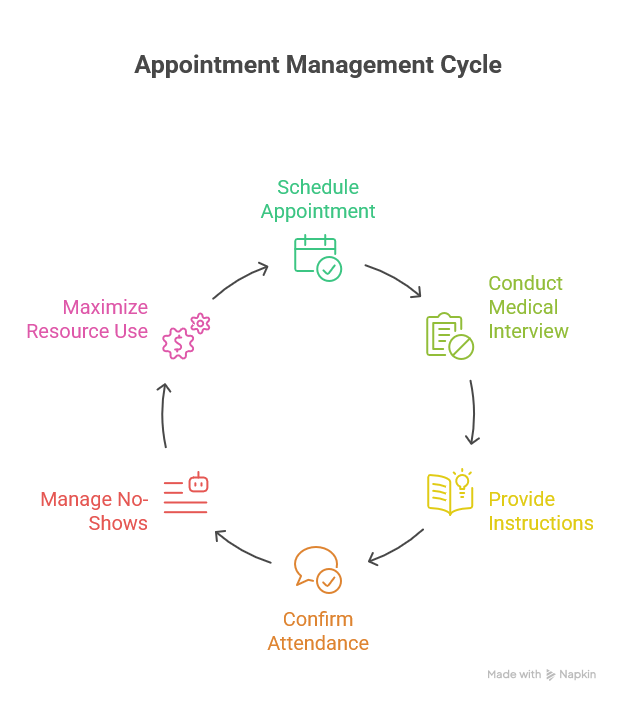
Registering for MRI or CT scans is a much more complex process than booking an appointment with a general practitioner. It requires collecting a detailed medical interview and providing instructions, failure to follow which may result in the examination being impossible to perform and in the loss of valuable equipment operating time.
Managing “No-Shows”
A key problem for diagnostic departments is the so-called no-show rate. By using medical voicebots, facilities can implement multi-stage appointment confirmation. The system not only reminds patients of the appointment, but also requests interactive confirmation of attendance. In the event of a cancellation, AI immediately offers the freed slot to patients on the waiting list, maximizing the use of National Health Fund (NFZ) contracts or commercial revenue.
2. The role of the voicebot in preparing patients for examinations
Lack of up-to-date creatinine test results or accidental food intake before a contrast-enhanced examination are among the most common reasons patients are turned away on the day of the exam.
Intelligent guidance (Pre-scan Protocol)
The EasyCall virtual receptionist can execute scenarios tailored to the specific type of examination:
- For CT scans: Reminders about proper hydration and bringing kidney function test results.
- For MRI scans: A detailed questionnaire regarding pacemakers, metal fragments, or claustrophobia.
- For X-ray examinations: Information about removing jewelry and wearing appropriate clothing.
As a result, patients arrive properly prepared, which shortens time spent in the examination room and increases department throughput. Such a communication strategy builds trust and a sense of care. It is worth remembering that KPO D1.1.2 funds for healthcare facilities can be allocated to AI and voicebots.
3. System integration: RIS, HIS, and PACS
For automation to make semantic and operational sense, the AI voicebot must be integrated with the facility’s IT systems. In diagnostic imaging, this means integration with the RIS (Radiology Information System) and HIS.
Real-time data flow
When a patient speaks with the bot, the system verifies appointment availability in the RIS module. If the patient reports a contraindication (e.g., a metal implant before MRI), the bot can automatically flag this information in the HIS system, allowing staff to perform earlier medical verification without making additional phone calls. Experience from implementations such as call centers for private hospitals confirms that automated information flow reduces human errors by nearly 40%.
4. Scalability and handling call volume peaks
Diagnostic departments often struggle with waves of incoming calls after new NFZ contracts are announced or during morning hours. Traditional contact centers are often unable to handle 100% of the traffic, leading to patient frustration.
Automation ensures that every caller receives an immediate response. Even if the issue is too complex for the bot, the system collects basic data (national ID number, type of examination) and forwards it to a staff member, saving time otherwise spent gathering preliminary information. This solution directly contributes to a reduction in unanswered calls, which is crucial for maintaining diagnostic continuity.
Table: Comparison of manual and automated (AI) registration effectiveness
| Functionality | Manual registration (Human) | Automated registration (AI Voicebot) | Benefit for the department |
|---|---|---|---|
| Registration time | 5–10 minutes | 2–3 minutes | Increase in number of bookings by 50% |
| Medical interview | Dependent on staff experience | Standardized medical protocol | Higher patient safety |
| Availability | 8:00–16:00 | 24/7/365 | Full utilization of night and weekend slots |
| Reminders | Often omitted (lack of time) | Automatic (SMS + Voice) | Reduction of no-shows to a minimum |
| Instruction delivery | Verbal (patient forgets) | Voice + automatic PDF/SMS delivery | Better patient preparation |