
AI Voice Analytics: How Voicebot data builds competitive advantage
AI Voice Analytics: How Voicebot data builds competitive advantage
Most companies treat communication automation merely as a way to reduce costs. That, however, is only the tip of the iceberg. The real value in 2026 lies in the data generated by every minute of conversation between artificial intelligence and customers. AI voice analytics transforms thousands of hours of calls into structured business intelligence. Through integration with advanced models, the Voicebot ceases to be just a “call answerer” and becomes the most powerful Business Intelligence tool in your organization.
In brief: Key takeaways from the article
- Real-time sentiment analysis enables immediate detection of trends in customer satisfaction or frustration without the need to listen to recordings.
- Automatic intent tagging provides precise data on the issues most frequently raised by patients or logistics partners.
- Voicebot data integrated with CRM systems enables offer personalization and prediction of purchasing behavior (Predictive Analytics).
- Voice analytics in healthcare helps identify the most common reasons for appointment cancellations, enabling optimization of the entire facility’s operations.
- 360-degree reporting gives management insight into process bottlenecks that are invisible in traditional call center statistics.
From recording to chart: How AI “reads” conversations
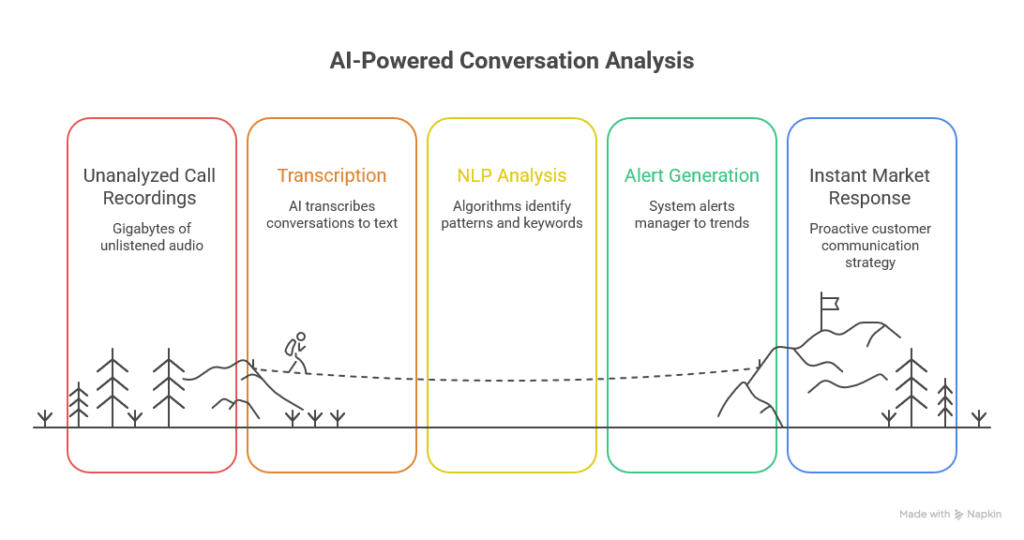
Traditional call centers collect hundreds of gigabytes of recordings that no one is able to listen to in full. Managers rely on sample-based quality checks, which carry the risk of statistical error. AI Voicebots change this paradigm. Every conversation is automatically transcribed and analyzed by NLP (Natural Language Processing) algorithms.
The system recognizes not only words, but also patterns. If within one hour 50 patients ask about a “new cardiologist,” the system immediately sends an alert to the clinic manager. Such a customer communication strategy enables an instant response to market needs—something no other feedback collection method can provide.
Sentiment analysis: The customer’s voice as a brand barometer
In 2026, LMM technology enables emotion analysis with unprecedented precision. The Voicebot analyzes intonation, speech tempo, and voice intensity. As a result, an emotional map of your business is created. It’s a true “game changer” in voice communication.
For medical facilities, where reducing the number of missed calls is critical, voice analytics makes it possible to verify whether automation has negatively affected patient comfort. If the data shows that patients react calmly and positively to bot assistance, the facility has a green light for further digitization. In the commercial sector, sentiment analytics helps identify moments when customers are most inclined to make a purchase or renew a contract.
Table: Traditional statistics vs. EasyCall AI analytics
| Metric | Traditional statistics (IVR/Human) | AI Analytics (Voicebot 2.0) | Business benefit |
|---|---|---|---|
| Main conversation topic | Manually selected by agent (often incorrectly) | Automatic intent clustering | Precise insight into customer problems |
| Customer mood | Subjective employee assessment | Objective AI sentiment analysis | Early detection of reputational crises |
| Bottlenecks | Call duration analysis | Detection of “confusion” points in dialogue | Continuous optimization of call scenarios |
| Transactional data | Manually entered into CRM | Automatic export to HIS/CRM | 100% data accuracy |
| Quality monitoring | Sample listening (1–2% of calls) | Audit of 100% of conversations | Full control over service standards |
Optimization of medical and logistics processes
In healthcare, voice analytics enables deep schedule optimization. If medical voicebots report that 30% of calls concern requests to reschedule appointments due to missing test results, management can decide to send automatic reminders about results two days before the visit. This significantly reduces “empty runs” in medical offices.
In the TSL industry, inbound query analysis helps identify at which stage of delivery customers feel the most anxiety. If most questions concern the “last mile,” the company can implement a more precise SMS notification system with courier location details. Experience from call centers for private hospitals shows that such data is invaluable when planning investments in additional automation modules.
Security and anonymization of analytical data
Using AI to analyze call content places a high level of responsibility on the provider. At EasyCall, we apply advanced anonymization mechanisms (masking of sensitive data). Before a conversation enters the analytics module, data such as national ID numbers, addresses, or debt amounts can be hidden to ensure the highest level of data security in voicebot systems. As a result, managers receive clean trends and statistics without any risk of violating individual privacy.

Knowledge is the new currency in customer service
Deploying a Voicebot is only the beginning of the journey toward optimizing your business. The real advantage emerges when you start listening to what your data is telling you. EasyCall’s AI voice analytics is the key to understanding patient and customer needs—something no satisfaction survey can replace.
Would you like to see what hidden trends are embedded in your telephone communications? Our experts will help you configure an analytics dashboard that turns conversations into concrete business decisions. Contact EasyCall and start managing your company based on facts rather than intuition.
FAQ – Voice analytics and Voicebot data
Do I need a data specialist (Data Scientist) to use AI analytics?
No. The EasyCall administrative panel presents data in the form of clear charts and ready-made reports. The system automatically extracts key insights and presents them in a way that is understandable for managers and facility directors.
What conversation data from the bot can be automatically sent to my CRM system?
Practically any data. From call status (e.g., “appointment confirmed”), through declarations (e.g., “I will pay on Friday”), to specific medical or logistics parameters provided by the customer. Everything depends on the API interface configuration.
Can the system analyze conversations conducted by my employees, not only by the bot?
Yes. Our analytical modules can be used to analyze the entire traffic in your contact center. This allows comparison of bot and human effectiveness and identification of best communication practices within your team.
Does sentiment analysis work correctly if a customer has a specific way of speaking?
AI 2.0 systems learn speech patterns rather than single tones. As a result, they can distinguish naturally loud speech from genuine frustration. The accuracy of this analysis increases with the number of conversations processed.
How does voice analytics help in accounting for grants, e.g., from the KPO?
This is one of the strongest arguments. Bot-generated reports provide hard data on the implementation of e-services, the number of patients served, and time savings. These are ideal indicators (KPIs) for reporting the sustainability and success of EU-funded projects.
Can I receive real-time notifications about negative conversations?
Yes. We can configure the system so that when strong customer dissatisfaction is detected (via sentiment analysis), a manager immediately receives an email or system alert along with a link to the conversation transcript.
Can bot data help in training my employees?
Definitely. Analysis of the most frequent questions and the most effective dialogue paths used by the bot provides ready-made material for a knowledge base for new consultants. The bot becomes a quality benchmark for the entire service department.
Does the analytics system recognize different languages and dialects?
Yes, our voice analytics is multilingual. The system can report trends separately for different markets (e.g., Polish and English), which is essential for logistics companies operating internationally.
