
Voicebot in logistics: How to automatically handle 80% of inquiries?
Voicebot in logistics: How to automatically handle 80% of inquiries?
In the dynamically developing TSL (Transport, Freight Forwarding, Logistics) sector and e-commerce, effective customer communication is just as important as on-time delivery. Every day, customer service departments are flooded with thousands of questions about shipment status, delivery time changes, or complaint procedures. In 2026, manual handling of these inquiries becomes not only inefficient but also unprofitable. The solution redefining industry standards is the voicebot in logistics—an intelligent assistant capable of independently handling up to 80% of incoming traffic.
In brief: Key takeaways from the article
- Inbound automation enables immediate handling of 100% of calls, eliminating queues in customer service offices.
- Logistics voicebots are most effective with repetitive inquiries, such as checking parcel status or changing a delivery address.
- Integration with TMS and CRM systems allows the bot to provide real-time information based on a consignment note number or phone number.
- Solution scalability enables logistics companies to handle sales peaks (e.g., Black Friday or the pre-holiday period) without stress.
- Implementing AI significantly reduces the unit cost of handling a case, allowing consultants to focus on more complex issues and complaints.
Modern logistics requires immediacy
Customers expect information “here and now.” In the era of online shopping, uncertainty about a shipment’s whereabouts generates anxiety, which immediately translates into a call to customer service. Traditional call centers are often unable to respond quickly enough, leading to abandoned calls and negative online reviews. Intelligent TSL provides ideal support for handling claims and shipment status inquiries.
The use of an AI voicebot changes this dynamic. The bot does not need breaks, does not get sick, and can conduct hundreds of conversations simultaneously. As a result, every person calling a logistics company receives an answer on the first ring. This is the foundation of a modern customer communication strategy focused on maximizing end-customer satisfaction.
Which logistics processes are taken over by artificial intelligence?
Achieving an automation rate of up to 80% stems from the fact that most interactions in logistics are structured inquiries. A voicebot excels at processes that require data verification within systems and providing a concrete response.
- Checking shipment status (Track & Trace)
This is the most common reason for contact. The bot identifies the customer by phone number or asks them to dictate the consignment note number. Thanks to advanced speech recognition (ASR), the system accurately interprets sequences of digits and letters, retrieves data from the TMS (Transport Management System), and informs the customer: “Your parcel is currently at the sorting facility in Łódź, and the planned delivery is tomorrow by 2:00 PM.”
2. Managing delivery date and location
If the customer knows they will not be at home, the virtual consultant can offer a change of delivery date or redirect the parcel to the nearest pickup point (PUDO). All of this happens during a short voice conversation, and the changes are immediately saved in the courier system.
3. Handling complaints and incidents
In the case of damaged shipments or delays, the bot can accept an initial report, assign it a case number, and inform the customer about required documents (e.g., photos of the damage). If the situation requires human intervention, the bot transfers the call to a specialized contact center employee, passing along all information collected so far.
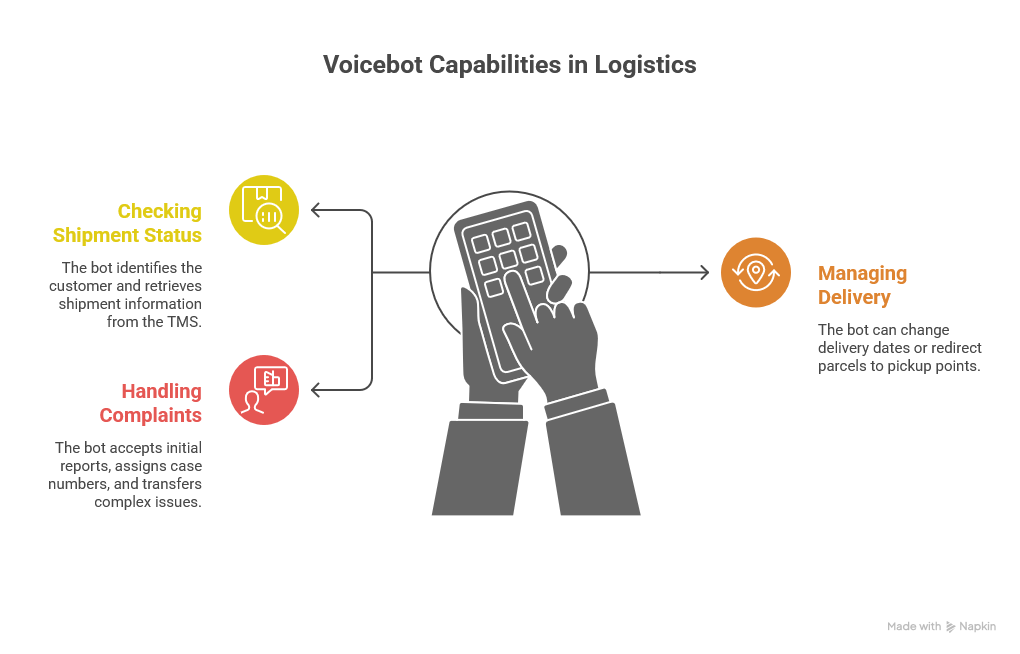
Table: Potential for inquiry automation in the logistics industry
| Type of inquiry | Possible automation level | Role of the AI voicebot | Impact on efficiency |
|---|---|---|---|
| Where is my parcel? | 95% | Reading status from the database | Drastic reduction in call duration |
| Change of delivery address | 80% | Code verification and TMS update | Avoidance of incorrect courier visits |
| Pricing / offer inquiry | 90% | Providing standard information | Reduced burden on the sales department |
| Filing a complaint | 50% | Data intake and case number assignment | Standardization of complaint processes |
| Contact with courier | 70% | Forwarding contact request / number | Improved “last mile” communication |
Business benefits: ROI and operational efficiency
For logistics managers, a key metric is the cost per interaction. A human consultant can handle a limited number of calls per hour. A voicebot does not have these constraints. The cost per minute of a bot’s work is a fraction of a human’s cost, and its efficiency is incomparably higher during sudden spikes in call volume (e.g., before holidays).
It is also worth noting the qualitative aspect. Automating repetitive tasks prevents customer service employees from experiencing burnout caused by constantly answering the same questions. They can devote their time to resolving difficult, non-standard problems, which genuinely improves service quality. Experiences from other industries, such as healthcare—where a decrease in missed calls has been recorded—show that 24/7 availability builds a significant competitive advantage.
Security and integration – the foundations of the system
In logistics, we operate on address and contact data of millions of people. Therefore, data security in voicebots must be at the highest level. EasyCall systems guarantee full encryption and compliance with GDPR, which is crucial for trust in B2B and B2C relationships.
Porozmawiaj z naszym specjalistą
Another pillar is integration. For a bot to handle 80% of inquiries, it must have access to the “heart” of the company—systems such as WMS, TMS, or ERP. Thanks to flexible API interfaces, implementing a voice assistant runs smoothly and enables two-way information exchange: the bot not only reads data but can also modify it (e.g., adding a note for the courier).
Summary: The logistics of the future starts with a conversation
Automating communication in logistics is not only a way to save costs but, above all, an investment in business scalability. A voicebot allows logistics companies to grow without the need to proportionally increase employment in customer service departments. With intelligent assistants, processes such as checking shipment status or handling complaints become faster, cheaper, and more precise.
Do you want to cut customer service costs in your logistics company by half? Our experts will help you identify processes ready for automation and prepare dedicated conversation scenarios. Contact EasyCall and see how AI can drive your business.
FAQ – Voicebot in logistics and transport
Can a voicebot handle different accents and background noise?
Yes. Modern systems based on Voicebot 2.0 technology use advanced noise-reduction algorithms and deep learning models, enabling precise speech recognition even when the customer calls from a noisy street or warehouse.
How will customers react to talking to a machine instead of a human?
Studies show that for logistics customers, speed and accuracy of information are most important. If a bot provides precise shipment status information within 30 seconds, customer satisfaction is higher than after waiting 5 minutes to connect with a consultant.
Can a voicebot make outbound calls, e.g., to notify about a failure?
Of course. This is one of the most effective use cases. In the event of a sorting facility failure or transport delay, the bot can make thousands of calls within minutes to inform recipients about the situation and propose new dates, preventing inbound hotline overload.
How long does it take to implement a logistics bot in a mid-sized courier company?
A typical implementation, including process analysis, scenario configuration, and integration with the shipment tracking system, takes 6 to 10 weeks. The first effects—such as reduced phone line load—are visible immediately after production launch.
Can the bot handle international shipments and speak multiple languages?
Yes. Our solutions support multilingual capabilities. The bot can automatically recognize the customer’s language (e.g., based on country code or first utterance) and seamlessly switch to service in English, German, or Ukrainian.
What happens if a customer swears or is very upset?
EasyCall AI systems include a sentiment analysis module. If the bot detects a high level of aggression or frustration it cannot handle, it immediately offers to transfer the call to a supervisor or specialized consultant, passing along the reason for the customer’s distress.
Does implementing a bot require changing the company’s phone numbering?
No. The voicebot integrates with your existing telephone exchange. It can act as a first line of support (next-generation IVR), directing only complex cases to your employees’ internal numbers.
Can the system collect feedback on courier performance after delivery?
Yes. This is an excellent tool for measuring NPS (Net Promoter Score). The bot can call the customer a few hours after delivery with a short service rating question. The effectiveness of collecting feedback this way is significantly higher than with email surveys.
