
The Ideal Ecosystem: Benefits of integrating a Voicebot with a HIS system
The Ideal Ecosystem: Benefits of integrating a Voicebot with a HIS system
In the era of digital transformation in healthcare, the success of a medical facility depends on how efficiently data flows between its individual components. Even the most advanced artificial intelligence will not fulfill its role if it operates in isolation. The real revolution begins when communication tools become an integral part of the facility’s management system. Combining an intelligent voice assistant with a HIS (Hospital Information System) creates an ideal ecosystem—one in which technology works for both staff and patients in real time.
In brief: Key takeaways from the article
- Full integration of the Voicebot with the HIS eliminates the need for manual transcription of data from phone calls into physicians’ schedules.
- Automatic patient identity verification based on the HIS database increases security and shortens the handling time of each request.
- Real-time synchronization allows the bot to offer patients only genuinely available appointment slots, avoiding the risk of overlapping visits (so-called overbooking).
- Bidirectional data exchange ensures that any information about appointment cancellations or rescheduling is immediately visible to registration staff.
- Implementation of the EasyCall ecosystem supports the achievement of milestones in digitization projects financed from external funds.
The foundation of e-health: Why system “conversations” are critical
The HIS system is the operational brain of every modern clinic and hospital. It contains medical documentation, specialists’ work schedules, and treatment histories. When medical voicebots are added to this structure, they cease to be merely tools for answering phone calls. They become active participants in the medical process.
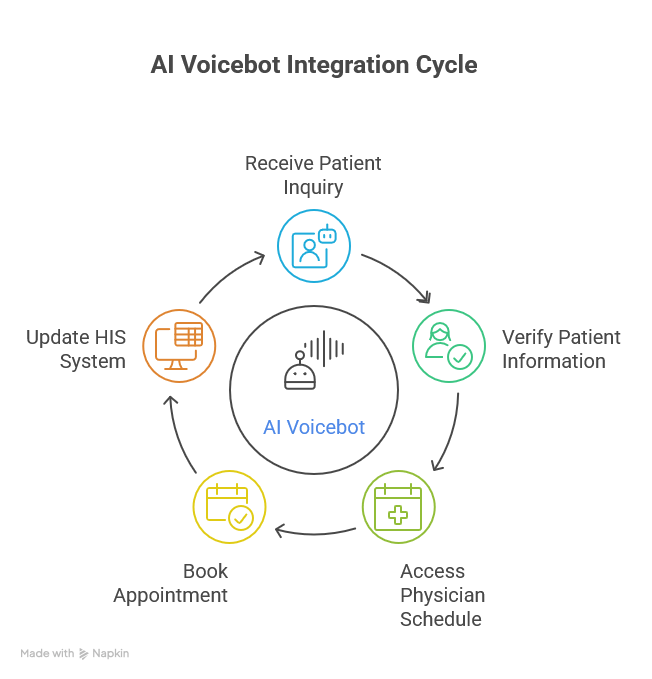
Without integration, the bot would have to pass call reports to staff members, who would then manually enter data into the system. This generates delays and the risk of errors. In the ideal ecosystem, the AI voicebot independently “reads” available slots in a physician’s schedule and “books” the patient into them after successful verification. Everything happens in a fraction of a second, without human involvement.
Data security and reliability: From national ID numbers to patient records
One of the most important aspects of integration is authorization. Thanks to the connection with the HIS database, the virtual receptionist can ask the patient for their national identification number (PESEL) and immediately verify whether they exist in the records. This enables personalization of the conversation—the bot can address the patient by name or refer to their scheduled examinations.
Such an approach significantly increases data security in voicebot systems. Information is not stored in external files but transmitted directly to the facility’s protected medical database via encrypted API protocols. In this way, full data continuity (Data Integrity) is preserved, which is crucial in an era of strict GDPR compliance audits.
Table: Benefits of integrating a Voicebot with a HIS system
| Process area | Operation without integration | Integrated ecosystem (EasyCall + HIS) | Business benefit |
|---|---|---|---|
| Appointment booking | Bot report sent to staff email | Automatic entry into the HIS schedule | 100% registration time savings |
| Appointment cancellation | Staff must manually free the slot | Slot released immediately after the call | Higher utilization of equipment (MRI/CT) |
| Patient verification | Manual database lookup | Automatic recognition via ID/phone number | Higher security and error elimination |
| Statistical data | Manual preparation of reports | Reports generated automatically in BI | Better resource planning |
| Post-visit communication | SMS sent from a separate system | Bot calls automatically after HIS entry | Higher NPS (patient satisfaction) |
Optimizing staff work and relieving registration desks
Facility directors often ask about the real return on investment (ROI). The greatest gains come from time savings. Our experience from implementations such as call centers for private hospitals shows that an integrated system takes over the most tedious tasks.
Registration staff no longer have to answer calls such as: “What time is my appointment tomorrow?” or “Do I need to be fasting?” The bot, using data from the HIS system, provides these answers precisely and instantly. As a result, staff can focus on serving patients who are physically present at the facility or on coordinating complex medical procedures. A communication strategy designed in this way makes work more structured and predictable.
Effectiveness confirmed by real-world implementations
Integration is not just theory. In practice, it enables a significant increase in efficiency in large public institutions. One example is the reduction in the number of missed calls at a hospital in Kraków. The key to success was the smooth exchange of information between the telephony layer and the hospital database. A patient who reaches the facility and immediately receives specific information about their examination feels cared for and develops greater trust in the institution. Discover five real funding sources your medical facility can use to implement this technology.

Summary: Technology that understands your system
Creating an ideal ecosystem in a medical facility is a process that requires not only good software but also an experienced partner. Integrating a Voicebot with a HIS system is the step that separates simple automata from professional medical support systems. Thanks to this synergy, your facility gains time, security, and an unprecedented level of precision in patient service.
Would you like to check whether your HIS system is ready to cooperate with our Voicebot? Our engineers will conduct a free technical audit of integration possibilities for you. Contact EasyCall and start building your ideal ecosystem today.
FAQ – Voicebot integration with medical systems
Which HIS systems can the EasyCall voicebot integrate with?
Our solution is flexible and can communicate with most popular systems on the Polish market, such as Kamsoft (Somed, Kamsoft Szpital), Asseco (AMMS, mMedica), CGM, or Infomedica. We use modern API interfaces or data buses, ensuring a stable connection.
Is integration with the HIS system secure for patient data?
Security is our top priority. The connection is established via encrypted tunnels (e.g., VPN) and uses authorization protocols that prevent unauthorized access. The entire process is fully compliant with GDPR and cybersecurity requirements for the medical sector.
How long does the process of integrating the bot with a facility’s IT system take?
Implementation time depends on the complexity of schedules and the scope of data the bot is to process. Typically, the process takes from 4 to 8 weeks, including testing in a development environment, to ensure that deployment does not disrupt physicians’ work.
What happens if the HIS system experiences downtime or a technical failure?
In such a situation, the voicebot switches to emergency mode. Instead of making direct entries in the schedule, it collects the necessary information from the patient and stores it in a waiting queue. When the HIS system is restored, the data is synchronized and staff receive a notification to verify the entries.
Does implementing an integrated bot require purchasing new server infrastructure?
No. The EasyCall system operates in a cloud or hybrid model. This means that on the facility’s side, only a secure integration point (API) needs to be provided, while all computing power and AI logic reside on our side.
Can the voicebot automatically send medical survey results collected by phone to the HIS system?
Yes, this is one of the most valued features. The bot can conduct an epidemiological interview or a satisfaction survey, and the results (in structured form or as a transcription) are sent directly to the patient record or a dedicated reporting module in the HIS.
After integration, does registration staff still retain control over the schedule?
Of course. The AI system is an “assistant,” not a supervisor. Staff have real-time visibility into all bot actions and can modify or delete any entry made by artificial intelligence at any time. The bot only executes tasks according to the permissions granted to it.
Does integration enable handling of e-referrals and e-prescriptions?
Yes. An integrated virtual consultant can ask the patient for the e-referral code, verify it in the database (via the HIS and the P1 system), and then propose an appointment date directly based on the content of that referral.
