
How to prepare your team for working with AI?
How to prepare your team for working with AI?
Preparing a team to work with AI is essential to reduce the risk of unnecessary resistance or reluctance toward these tools. It requires an appropriate educational strategy focused on developing a better understanding of the potential of artificial intelligence and demonstrating the benefits of using it. Discover a set of practical tips on how to prepare your company’s team for working with AI.
Careful planning of the implementation process is essential
Implementing AI in a company is a complex process that should be planned in advance. Rushing is not recommended, as it can lead to poor business decisions and inaccuracies in selecting and later implementing the tools. It is advisable to precede the technological changes with an informational campaign and a series of training sessions for employees, which will help the team better prepare for what’s coming. This will facilitate the implementation itself and increase employee engagement in the process while maintaining high motivation.
Education as the foundation for preparing the team to work with AI
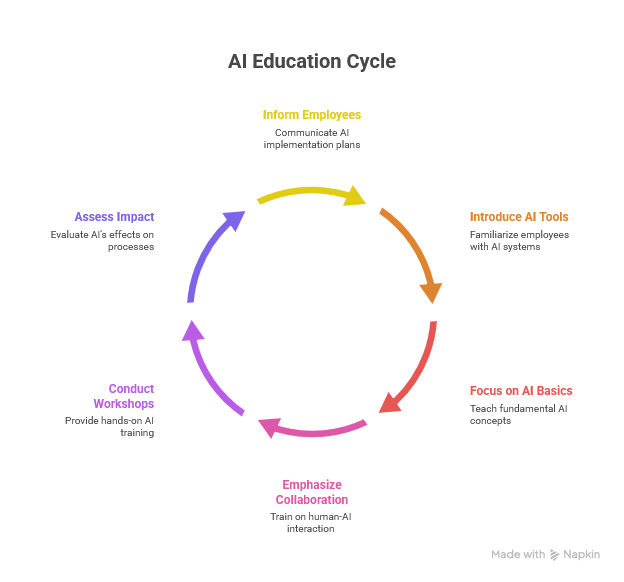
Education is the foundation of preparing a team to work with AI. The first stage is to inform employees about the intention to implement AI-based tools to automate daily work and increase efficiency. Special attention should be given to individuals directly involved in handling AI systems. They should be introduced to the specifics of these tools as well as the benefits associated with their implementation. The education process should focus on areas such as:
- the basics of how artificial intelligence works;
- best practices for human–AI collaboration, along with examples;
- workshop sessions such as “how to work with a voicebot and other AI tools”;
- the capabilities, limitations, and impact of AI on selected business processes.
In the context of medical services, education is crucial in determining whether the registration desk enjoys working with a voicebot or does so reluctantly. The same applies to every other industry where artificial intelligence can be used to automate daily tasks.
AI as a partner, not a threat
The team must shift its mindset and treat AI as support and a partner in daily work, not a threat to their jobs. Unfortunately, employees often fear job loss or a reduced role in business processes because AI is expected to take over some tasks. As a result, resistance frequently appears—both toward implementation and later toward effective use. The team should understand that AI is meant to lighten their workload and take over many routine tasks. Meanwhile, employees can focus on the most important matters and more complex issues. As an entrepreneur, plan a communication strategy aimed at changing employees’ attitudes toward AI and positioning it as a partner rather than a threat. If you run a medical facility, check how to prepare your registration team to work with a voicebot in a clinic.
Porozmawiaj z naszym specjalistą
Clearly defining roles and responsibilities within the team
It is the manager’s responsibility to clearly define the roles and responsibilities of individual team members involved in the implementation and operation of AI tools, including voicebots, chatbots, and others. In practice, this means:
- identifying employees or positions that will supervise AI tools in the company,
- defining which areas will be taken over by artificial intelligence and which will remain handled by consultants,
- defining the role of AI as a member of the team and specifying its functions.

Providing the necessary infrastructure
Even the most engaged team will not complete its tasks effectively if it is not given the required infrastructure. That’s why it is the company’s responsibility to ensure access to appropriate tools, such as electronic hardware and systems with a clear and user-friendly interface. Additionally, procedures related to work organization and process optimization must be prepared. Beyond implementation itself, pay attention to the feedback stage. Team members should be involved in evaluating the tool so you can identify its benefits and areas that require improvement. All of this helps maintain high efficiency in the human + AI work model and keep the team motivated.
Allowing room for flexibility
Artificial intelligence leaves plenty of room for experimentation and improvement. Therefore, it is worth nurturing a culture of experimentation within the company. Provide employees with the necessary support and encourage them to test new possibilities and explore the potential of AI. This will accelerate tool mastery and offer opportunities to enhance automation efficiency or discover new areas for applying AI within your business. Of course, you cannot rest on your laurels. After implementation, you must continue working on improving AI usage in the company and actively involve the team in this effort. As a result, the team will be even more willing to use the tools provided to them.
We will help you with the implementation – contact us
At EasyCall, we have been specializing for years in implementing artificial intelligence in companies across various sectors. We support both the technical aspects and the preparation of teams for change, as well as the effective use of AI in practice. Explore the stories of our clients and find inspiration—you will find organizations similar to your own. Wondering how to use AI in your business and which areas can be automated? Contact our expert, who will present various options and guide you through the entire process.
