
AI in healthcare 2026: 5 real funding sources your medical facility can use
AI in healthcare 2026: 5 real funding sources your medical facility can use
In 2026, the Polish healthcare system is undergoing an unprecedented transformation. Artificial intelligence has ceased to be a futuristic add-on and has become a foundation of operational efficiency. However, for many hospital directors and clinic owners, the key barrier remains financing. Thanks to a combination of EU funds, national programs, and new sustainable development mechanisms, opportunities to secure capital for AI technologies are greater than ever before.
In brief: Key takeaways from the article
- KPO and FEnIKS remain the main pillars for financing large-scale AI implementations and clinical decision support systems in hospitals.
- Regional Operational Programs offer dedicated paths for SMEs, enabling the digitalization of local clinics and specialist practices.
- In 2026, artificial intelligence is treated as an eligible expense, supporting, among other things, accessibility for people with disabilities.
- Data security and interoperability (compatibility with HIS systems) are mandatory conditions for a positive grant evaluation.
- EasyCall supports healthcare facilities not only technologically, but also substantively in the process of preparing grant documentation.
1. National Recovery Plan (KPO) – Investments D1.1.2 and D1.2.1
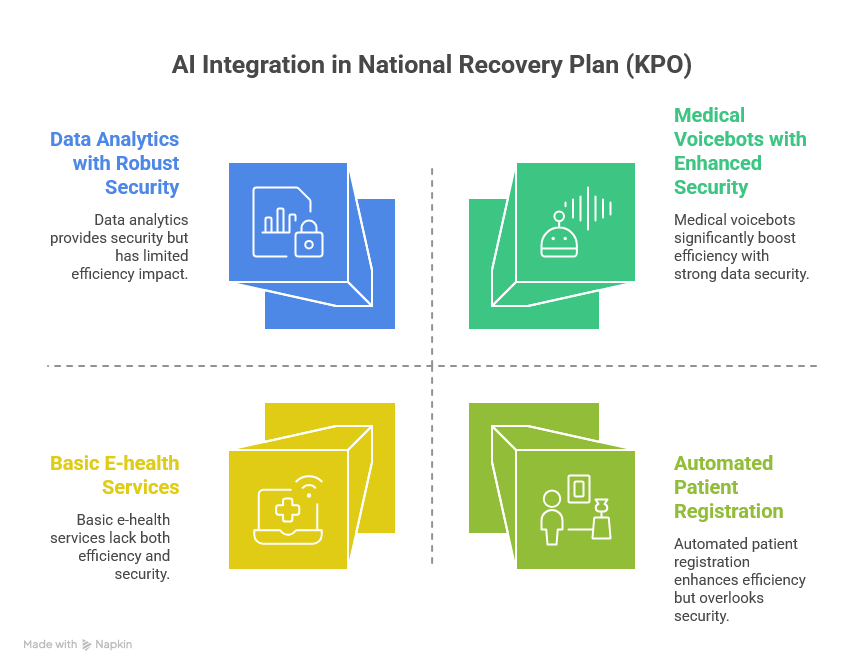
Although KPO has been discussed for a long time, 2026 is a critical year due to the accumulation of settlements and the final calls for so-called “rapid response” projects. Investment D1.1.2 focuses on data analytics and e-health.
Why does AI fit perfectly into KPO?
EU project search engines and evaluation systems promote solutions that genuinely increase the efficiency of the healthcare system. Implementing medical voicebots allows facilities to meet KPIs related to the number of e-services delivered. Artificial intelligence that automates patient registration directly supports the so-called digitalization “milestones” of Poland.
It is also worth remembering that KPO promotes solutions that improve data security in voicebots, which is crucial in an era of growing cybersecurity threats in healthcare. EasyCall has the most extensive experience in the hospital market. See how to meet the digitization requirements in 2026.
2. FEnIKS Program (European Funds for Infrastructure, Climate, Environment)
The FEnIKS program for 2021–2027 (with continuation in 2026) is a powerful funding source for large entities. Under the healthcare sector support priority, funds can be allocated to modern equipment and IT systems.
Digitalization as an element of a “green” healthcare facility
AI in healthcare helps reduce the carbon footprint—for example, by optimizing patient logistics and reducing no-shows (missed appointments). Systems such as a virtual receptionist enable better planning of diagnostic imaging workflows, which translates into lower energy consumption by heavy equipment (MRI, CT) by eliminating schedule gaps.
3. Regional Operational Programs (ROP) – local support
In 2026, each voivodeship has its own pool of funds for innovation in SMEs. This is an ideal path for private medical centers and smaller clinics.
Building local competitive advantage
Thanks to ROPs, facilities can finance the implementation of a medical contact center system, significantly improving the quality of service for the local community. Regional funds often emphasize innovation at the regional level—implementing a bot based on LMM language models (Voicebot 2.0) almost always meets this criterion.
4. Medical Fund (Sub-Fund for the Modernization of Medical Entities)
This is a Polish financing mechanism that in 2026 focuses on digital security and modern diagnostics. The fund is particularly favorable toward projects that integrate dispersed medical data.
Integration as the superior entity
Within the Medical Fund, systems that “communicate” with central registers receive higher scores. Our experience from projects such as the reduction in missed calls at a hospital in Kraków shows that automating pre-visit data collection (medical interviews conducted by phone) is rated very highly by fund experts.

5. SMART Path (FENG) and NCBR grants
For medical facilities that conduct R&D activities or cooperate with universities, the FENG program offers financing for the entire innovation cycle—from concept to implementation of an AI voicebot.
Porozmawiaj z naszym specjalistą
Table: Comparison of AI funding sources in healthcare (2026)
| Funding source | Target beneficiary | Max. funding level | Key entity (priority) |
|---|---|---|---|
| KPO (D1.1.2) | Public hospitals and institutes | up to 100% | Interoperability and data analytics |
| FEnIKS | Large hospitals, specialist outpatient care | 80–85% | Energy efficiency and accessibility |
| ROP (Voivodeships) | Clinics, medical centers | 50–85% | Regional innovation and SME digitalization |
| Medical Fund | Medical entities (hospital networks) | variable | Security and modernization |
| FENG (SMART) | Medical–technology consortia | up to 80% | Research & Development (R&D), new algorithms |
How to prepare an effective application? The “AI-First” strategy
When preparing documentation, generalities should be avoided. Google, like grant reviewers, values concrete semantic relationships. It is worth describing the patient communication strategy as a coherent ecosystem in which AI is not an add-on module, but the core that improves workflow efficiency.
Durability and development
In 2026, not only implementation matters, but also sustainability. By choosing a cloud-based call center for private hospitals, a facility gains guaranteed system updates without the need for additional capital expenditures in the future.
Your facility at the forefront of digital healthcare
Securing AI funding in 2026 requires a strategic approach. It is not just about technology, but about embedding it in a broader context of patient well-being and system efficiency.
Do you need substantive support in preparing the technical description for your application? Our experts have experience in delivering documentation for EU co-financed projects. Contact EasyCall—together we will finance your digital revolution.
FAQ – AI Funding 2026
Can funding from different sources be combined for the same AI project?
The prohibition of double financing is very strict. You cannot finance the same purchase (e.g., a license for the same voicebot) from KPO and ROP simultaneously. However, you can phase a project—for example, finance server infrastructure from FEnIKS and the implementation of innovative voice algorithms from a regional program.
What AI provider certifications are required when settling EU grants?
In 2026, key certifications include those confirming security (ISO 27001) and compliance with the new AI Act (if the system qualifies as high-risk). EasyCall provides full compliance documentation, which facilitates post-investment audits.
Does funding cover the cost of integrating the bot with our existing HIS system?
Yes. Development work related to integration (APIs, data buses) is almost always considered an eligible cost. It is even recommended, as isolated systems receive lower scores in terms of interoperability.
Do funds cover the cost of “training” the bot and preparing conversation scenarios?
Yes. As part of advisory and implementation services, you can finance configuration, training language models on facility-specific data, and optimizing patient pathways.
Which KPIs are best to include in a grant application for a voicebot?
The most measurable and valued by funding bodies are: reduction in waiting time for information, percentage reduction in missed calls, number of patients using e-services, and administrative staff time savings expressed in man-hours (FTE).
Are there AI grants dedicated exclusively to dentistry or rehabilitation?
These are usually programs within ROPs. In 2026, many regions launched so-called “digitalization vouchers,” which are ideal for implementing a voicebot in a specialist clinic.
Can KPO funds be used for cloud-based (SaaS) voicebots?
Yes. The SaaS model is permissible, provided the contract guarantees access to the service during the project’s durability period. The medical cloud must also meet strict EU data localization requirements.
Is training doctors and registration staff to use the AI panel an eligible cost?
Yes. The “digital competencies of staff” component is almost always part of e-health projects, enabling full training of teams in interpreting data delivered by artificial intelligence.
How long does it take to receive a funding decision in 2026?
In the case of KPO, processes are accelerated and decisions are often made within 60–90 days. Regional programs may take longer (up to 6 months). Therefore, it is crucial to have a ready technical specification from a provider such as EasyCall already at the moment the call is announced.
