
Grants for healthcare in 2026
Grants for healthcare in 2026
A quiet transformation is currently underway in healthcare—one that is not visible in the headlines of operational programs, but clearly apparent in the evaluation of grant applications. Just a few years ago, it was sufficient for an institution to demonstrate that it would purchase equipment or renovate a ward. Today, funding bodies increasingly ask a different question: will the project tangibly increase patients’ access to healthcare services?
According to OECD data, Poland still ranks among the EU countries with one of the lower physician-to-population ratios. At the same time, population aging is increasing demand for healthcare services faster than the system is able to expand supply. In such circumstances, infrastructure alone does not solve the problem. The organization of the system and the efficiency of resource utilization become decisive factors.
As a result, in the current financial perspective, projects that increase the operational capacity of healthcare facilities are gaining importance—for example, through the digitalization of patient service processes, automation of registration systems, or improvements in information flow—rather than projects focused solely on equipment acquisition.
Where to look for funding and which projects make sense
The coming months will be marked by urgency, particularly in the context of the National Recovery Plan, which must be settled by August 2026. This timeline forces healthcare institutions to act quickly and precisely, while favoring projects that are well prepared and aligned with long-term systemic objectives.

Accessibility Plus (FERS) – an opportunity for specialist outpatient care
For specialist outpatient clinics, one of the more attractive sources of funding remains the “Accessibility Plus” program, implemented under the European Funds for Social Development. Many calls for proposals offer a very high co-financing rate, in some cases covering up to the full cost of the project.
However, a key element is the accessibility audit and demonstrating that the project genuinely reduces barriers for patients, particularly seniors and persons with disabilities. This may involve both infrastructural changes and digital solutions that facilitate contact with the facility or access to information about available services.
It is worth noting that in many cases, software supporting accessibility is not classified as a traditional fixed asset, which increases flexibility in planning the digital transformation of a healthcare facility.
FEnIKS for Primary Healthcare – investments linked to service accessibility
Primary healthcare providers may, in turn, benefit from funding under the FEnIKS program. The scope of support includes infrastructure and equipment, as well as digitalization projects and solutions that improve the organization of healthcare delivery.
Many calls include advance payment mechanisms, allowing institutions to begin investments without fully financing them from their own resources at the outset. At the same time, it is increasingly evident that infrastructural investments should be tied to a specific systemic outcome, such as increasing the number of patients served, shortening waiting times, or improving access to information.
Regional funding opportunities
Regional calls for proposals are also becoming increasingly significant. These often focus on the digitalization of public services and improving the quality of services provided to residents. Healthcare projects aligned with these objectives may secure funding, particularly if they demonstrate a measurable impact on the accessibility of local services.
In some regions, funding allocated to healthcare investments amounts to hundreds of millions of PLN and is directed toward areas of greatest epidemiological importance, such as oncology or cardiology. For healthcare providers, this represents a genuine development opportunity, provided that the project addresses specific regional needs.
FEnIKS – infrastructure yes, but only if it increases service accessibility
The FEnIKS program remains the largest source of funding for healthcare investments in Poland. It covers equipment, digitalization, and the development of healthcare services. However, the interpretation of such investments has evolved.
In practice, this means that modernizing a facility or purchasing medical equipment should be linked to a concrete systemic outcome. Today, evaluating institutions assess projects based on whether they will shorten waiting times for appointments, enable service delivery to a greater number of patients, or improve access to information about healthcare services.
Porozmawiaj z naszym specjalistą
This shift stems from a simple fact: increasing the number of devices without improving work organization does not increase service accessibility. Therefore, infrastructural projects are increasingly combined with digitalization elements, patient flow management systems, or process reorganization initiatives.
Why patient experience Is becoming a funding issue
In many EU countries, healthcare accessibility is now analyzed through the lens of patient experience. In its documents on healthcare digitalization, the European Commission emphasizes that the key factor is the system’s ability to respond quickly to citizens’ needs, rather than merely its technological equipment.
From this perspective, the organization of registration systems, information flow, and the ability to contact a healthcare facility become systemic components rather than operational details. This explains why projects related to digitalization of patient services or automation of communication processes increasingly find justification in EU strategic documents.
It also clarifies why application evaluations now include questions about patient service time, access to information, or communication organization. These are no longer matters of service quality alone, but of healthcare accessibility in a systemic sense.
Where healthcare facilities still lose points
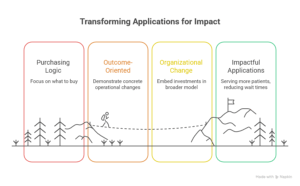
Observations from recent calls indicate that many applications are still prepared with a purchasing logic. Facilities focus on what they intend to buy, rather than demonstrating what will change in their operations.
Meanwhile, the highest-rated projects are those that translate investment into a concrete outcome: serving more patients, reducing waiting times, improving access to information, or utilizing staff more efficiently.
In practice, this means that even infrastructural investments should be embedded within a broader model of organizational change.
How to approach a grant project today
Healthcare institutions planning to apply for funding in 2026 should treat the project as an element of systemic transformation rather than a single investment. The best-rated initiatives are those that demonstrate how infrastructure, digitalization, and work organization complement one another.
Such an approach enables funding institutions to assess not only the cost of the investment but also its impact on the functioning of the healthcare system. This impact is increasingly becoming the key evaluation criterion.
Healthcare grants are no longer merely a tool for supplementing equipment. They are increasingly becoming an impulse for changing how institutions operate. Projects that can demonstrate an impact on service accessibility, work organization, and patient experience currently carry the greatest persuasive power.
In 2026, such initiatives will be most closely aligned with the direction of healthcare funding in Poland and the European Union.
Professional support in securing funding
Successfully obtaining grants requires not only a clear development vision, but also precise alignment with formal requirements. In this area, EasyCall works closely with experts in acquiring funding for modern technologies, including advanced voicebot systems. As a result, institutions can rely on comprehensive support—from selecting the appropriate technological solution to enhance communication, to professionally preparing the documentation necessary to finance the investment through external funding sources.

