
Voicebot and KPO – The largest experience in the hospital market. How to meet the digitalization requirements of 2026?
Voicebot and KPO – The largest experience in the hospital market. How to meet the digitalization requirements of 2026?
In the face of the largest wave of e-health funding in history, medical facilities are confronted not only with the challenge of choosing the right technology, but above all with selecting a partner who understands the specifics of the public sector. Investment under the National Recovery Plan (KPO) is a rigorous process in which implementation experience (Proven Track Record) is just as important as the technical parameters of the system itself.
An architecture of trust: Why hospital experience is critical?
The medical sector is characterized by a unique data structure and the critical nature of its processes. Unlike the e-commerce sector, an error in communication between a hospital and a patient can have direct health consequences.
Interoperability and HL7 FHIR standards
In projects financed by KPO, interoperability is a key requirement. Systems cannot operate as isolated “islands.” Our experience shows that effective implementation of a contact center system for medical facilities requires deep integration with HIS (Hospital Information System) platforms.
The EasyCall voicebot does not operate in isolation—it communicates with databases such as Kamsoft, Asseco, or CGM, using secure data exchange protocols. For a KPO auditor, this is a clear signal that the solution is durable and scalable.
Meeting KPO requirements: Security and project sustainability
European Union funding imposes strict guidelines regarding project sustainability (typically five years). When choosing an AI voicebot, a medical facility must be confident that the provider will remain on the market and that the technology will continue to be developed.
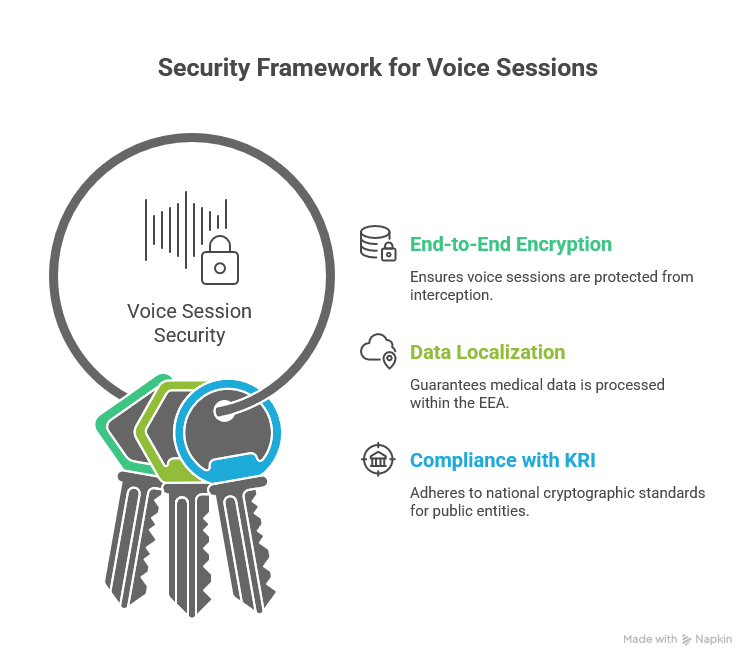
Key security attributes in the application documentation:
- End-to-End Encryption: Every voice session must be protected against interception.
- Data Localization (Sovereignty): Processing of medical data in cloud infrastructures located within the EEA (European Economic Area).
- Compliance with KRI: The National Interoperability Framework obliges public entities to apply specific cryptographic standards.
More information on how we address these aspects can be found in the article: data security in voicebots.
Operational optimization: Case Studies as the foundation of a grant application
When preparing a KPO funding application, it is essential to indicate measurable benefits (KPIs). The strongest argument for the evaluation committee is completed, real-world projects. One example is the reduction in unanswered calls at a hospital in Kraków, where automation enabled the system to handle 100% of telephone traffic during peak hours.
Table: Comparison of implementation parameters (Market Standard vs. EasyCall)
| Implementation parameter | KPO 2026 requirement | EasyCall standard | Impact on application scoring |
|---|---|---|---|
| HIS integration | Full (bidirectional) | Proprietary API connectors | Critical |
| Availability (SLA) | Min. 99.5% | 99.9% in distributed clusters | High |
| Speech processing (ASR) | Polish language (medical dialects) | Models dedicated to healthcare | High |
| GDPR compliance | Full (DPA/Data Processing Agreement) | ISO 27001 standard | Formal (must-have) |
| Accessibility for people with disabilities | WCAG 2.1 compliance | Voice User Interface (VUI) | Additional points |